Website vs Landing Page: Which One Generates More Leads for Your Business?
Uncover whether a website or a landing page is better for lead generation. Learn key differences, when to use each, and how to maximize conversions.
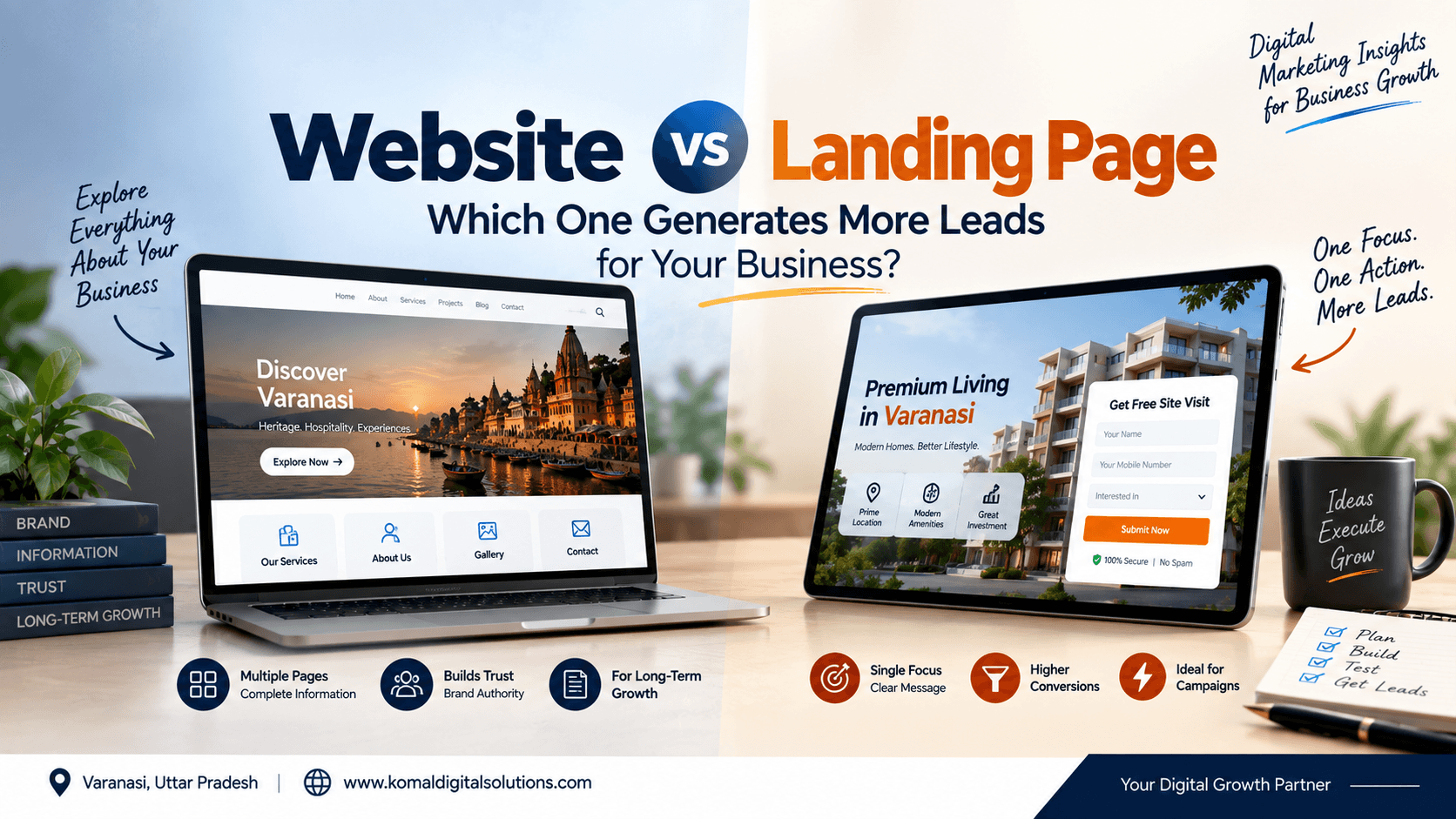
Navigating the digital landscape to capture new customers often brings a crucial question to the forefront for businesses: when it comes to lead generation, which performs better – a dedicated website vs landing page? As experts in digital strategy at Komal Digital Solutions, we understand that both serve vital purposes, yet their distinct architectures and objectives mean they excel in different scenarios for attracting and converting leads. Understanding these differences is key to optimizing your online presence and marketing campaigns for maximum impact.
Understanding the Fundamentals: Website vs. Landing Page
Before we dive into their lead generation capabilities, let's clarify what each entails.
What is a Website?
A website is a comprehensive digital hub designed to provide extensive information about a company, its products, services, and brand identity. It typically features multiple pages (e.g., Home, About Us, Services, Blog, Contact), allowing visitors to explore various aspects of the business.
Key Characteristics:
- Multi-purpose: Brand building, information dissemination, customer support, e-commerce, and more.
- Extensive navigation: Menus, internal links, and search functions encourage exploration.
- Broad audience appeal: Caters to visitors at different stages of the customer journey.
- SEO-focused: Designed for long-term organic traffic growth through diverse content.
What is a Landing Page?
A landing page, in contrast, is a standalone web page specifically designed for a single purpose: to convert visitors into leads or customers by prompting a specific action (e.g., filling out a form, making a purchase, downloading an ebook). Visitors typically arrive at a landing page after clicking on an advertisement, email link, or call to action from another source.
Key Characteristics:
- Single-minded focus: Zero distractions, hyper-focused on one offer and one conversion goal.
- Minimal navigation: Often no navigation menu to prevent visitors from straying.
- Targeted audience: Designed for specific market segments or campaign objectives.
- Call to Action (CTA): Prominently features a clear, compelling CTA.
- Measurable: Optimized for tracking specific conversion rates and A/B testing.
Key Differences in Lead Generation Approach
The fundamental difference between a website and a landing page lies in their core objectives and how they approach converting a visitor into a lead.
Objective & Focus
- Website: Aims to build brand awareness, establish authority, provide comprehensive information, and facilitate various user actions. Lead generation is one of many goals.
- Landing Page: Exclusively designed for lead capture. Every element, from headline to form field, is optimized to drive a single conversion. This laser focus often results in higher conversion rates for specific campaigns.
Content & Navigation
- Website: Rich content, extensive internal linking, and complex navigation allow users to explore at their leisure. This is great for informing, but can be distracting for direct lead generation.
- Landing Page: Minimalist content, stripped of external links or navigation, ensures the visitor's attention remains on the offer and the conversion form. The user experience is streamlined to guide them towards the CTA.
SEO & Traffic
- Website: Built for long-term SEO success, targeting a wide range of keywords to attract organic traffic over time. This organic reach helps in steady, passive lead flow.
- Landing Page: Primarily designed for paid traffic (PPC ads, social media ads) or specific referral traffic. While they can be optimized for niche keywords, their SEO impact is usually campaign-specific and less about broad organic presence.
Analytics & Optimization
- Website: Analytics track user journeys, page views, bounce rates across the entire site. Optimizing for lead generation often involves A/B testing specific page elements within a broader context.
- Landing Page: Highly conducive to precise A/B testing and conversion rate optimization (CRO). Every element can be tested and tweaked to improve the single conversion goal, offering clear, actionable data for maximizing leads.
When to Choose a Website for Lead Generation
While landing pages are conversion powerhouses, a well-optimized website is indispensable for sustained lead generation, especially for:
- Brand Authority & Trust: A comprehensive site builds credibility, which is vital for high-value leads. Visitors often check a company's main site before committing.
- Diverse Service Offerings: If you offer multiple products or services, your website is the place to showcase them all, attracting leads interested in different aspects of your business. Our web development services are designed to create robust platforms for this purpose.
- Long-Term SEO Strategy: For a continuous flow of organic leads, a content-rich website optimized for search engines is unmatched. It’s an investment that pays dividends over time through compounding traffic.

When to Choose a Landing Page for Lead Generation
Landing pages truly shine in specific, targeted lead generation scenarios:
- Specific Campaigns & Promotions: Running an ad campaign for a new product, a limited-time offer, or an event? A landing page ensures all ad clicks go to a page focused solely on that offer, eliminating distractions and boosting conversion rates.
- A/B Testing & Optimization: Their singular focus makes landing pages perfect for rigorously testing different headlines, images, CTAs, and forms to find what resonates best with your audience and generates the most leads.
- Quick Conversions & ROI: For rapid results and clear return on investment (ROI) tracking from paid marketing efforts, landing pages are invaluable. They streamline the user journey directly to the conversion point.
The Synergistic Approach: Using Both Effectively
The most effective lead generation strategy often doesn't force a choice between a website and a landing page, but rather leverages both in a synergistic manner.
Integrating Landing Pages with Your Main Website
Many businesses host their landing pages as subdomains or subdirectories of their main website (e.g., offer.yourcompany.com or yourcompany.com/offer). This allows them to benefit from the main site's domain authority while maintaining the landing page's distinct, conversion-focused design.
Full-Funnel Lead Nurturing
- Website for Awareness & Consideration: Your main website serves as the initial touchpoint for organic searches, building brand awareness and providing information during the consideration phase. Blog posts, 'About Us' pages, and service descriptions educate potential leads.
- Landing Pages for Decision & Action: Once a visitor shows interest (e.g., clicking on a specific service page or a blog post related to an offer), they can be directed to a dedicated landing page for a specific action, moving them further down the sales funnel.

Komal Digital Solutions' Perspective: Maximizing Your Lead Potential
At Komal Digital Solutions, we champion a balanced strategy. A robust, SEO-optimized website acts as your long-term digital foundation, establishing credibility and drawing in organic traffic. Complementing this, strategically designed landing pages become your high-conversion tools for specific campaigns, promotions, and paid advertising efforts. This dual approach ensures both sustainable growth and immediate results in lead generation.
For truly impactful lead generation, it's not about choosing one over the other, but understanding when and how to use each effectively within your comprehensive digital marketing strategy. We can help you identify the right blend for your unique business goals.
Frequently Asked Questions (FAQ)
Q1: Can a landing page replace a website?
No, a landing page cannot fully replace a website. While excellent for specific lead capture, it lacks the depth, navigation, and comprehensive information a website provides for brand building, long-term SEO, and diverse user needs. They serve different strategic purposes.
Q2: How many landing pages should I have?
The number of landing pages depends on your marketing strategy. For every specific campaign, product launch, or service offering that requires a distinct call to action, you should consider creating a dedicated landing page. Some businesses have dozens, or even hundreds, of landing pages to target different segments or offers.
Q3: Is SEO important for landing pages?
While many landing pages are primarily driven by paid traffic, optimizing them for SEO can still be beneficial. Using relevant keywords, clear meta descriptions, and fast loading times can improve their visibility in search results for very specific, long-tail queries, increasing organic lead potential. However, a full website remains the primary vehicle for broad SEO.
Conclusion
In the ongoing debate of website vs landing page for lead generation, the answer isn't a simple either/or. Both are powerful tools, each with distinct strengths. A well-designed website builds your brand's authority and serves as a content hub for organic leads, while meticulously crafted landing pages are precision instruments for capturing conversions from targeted campaigns. By integrating both strategically, businesses can create a comprehensive and highly effective lead generation ecosystem.
Ready to optimize your lead generation strategy? Contact us today to discuss how Komal Digital Solutions can help you implement a powerful website and landing page synergy that drives results.

Harshit Seth
Founder & Marketing Director
Harshit Seth is the founder and lead marketing director at Komal Digital Solutions. A veteran SEO strategist and digital growth marketer, he designs high-performing customer acquisition funnels, local SEO systems, and automation architecture to scale business revenues.